


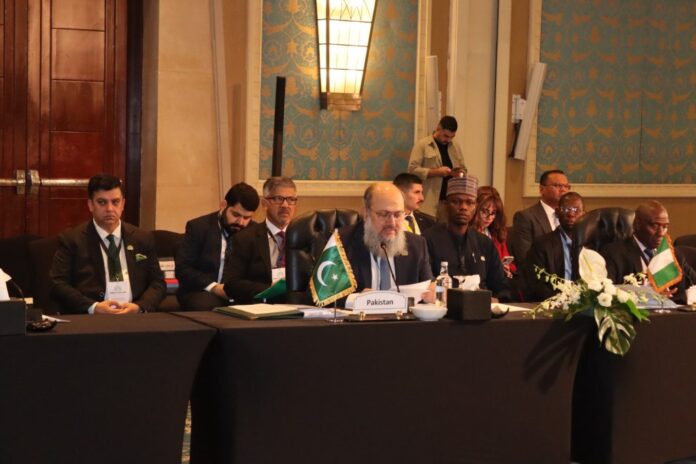
Pakistan reaffirmed its commitment to strengthening economic cooperation within the Developing-8 (D-8) bloc on Tuesday, with Federal Commerce Minister Jam Kamal Khan urging full implementation of the D-8 Preferential Trade Agreement to expand market access through tariff reductions, procedural simplification and harmonised documentation.
Addressing the 4th meeting of the D-8 Trade Ministerial Council in Cairo, Kamal highlighted the D-8 Preferential Trade Agreement (PTA) as a key instrument for boosting intra-bloc trade, calling for its full and effective implementation.
“By reducing tariffs, simplifying procedures and creating a predictable trading environment, the PTA can significantly expand market access,” he said, adding that Pakistan was committed to resolving operational issues and harmonising documentation to make the agreement fully functional.
Kamal Khan said the D-8 had become an important platform for countries with significant economic potential and shared development goals. He stressed that in an era marked by rising protectionism, climate-related disruptions, supply chain uncertainties and volatile commodity markets, regional alliances were essential for ensuring stability and sustained growth.
The commerce minister emphasised the need for stronger institutional mechanisms, including cooperation in customs, standardisation, mutual recognition and logistics connectivity. Efficient transport corridors and digital systems, he noted, were vital for smooth regional trade.
The commerce minister underscored the central role of the private sector in driving economic integration, urging greater business-to-business engagement, joint ventures and technology partnerships among member states.
He also highlighted opportunities in sustainable development, food security, energy, agriculture and textiles, saying the D-8 could serve as a model for South-South cooperation.
As regards the evolving global economy, he stressed the need to embrace digital transformation, including e-commerce, fintech and digital payments. Pakistan, he said, was keen to collaborate on strengthening digital infrastructure and innovation networks across the bloc.
“A more connected D-8 community can significantly enhance economic resilience and regional stability,” he said, expressing confidence that the Cairo deliberations would help shape a more integrated and prosperous future for member states.
The minister thanked the Government of Egypt for hosting the session and welcomed Azerbaijan as the group’s ninth member, noting that its inclusion would further enhance collective economic strength and cooperation.