


ISLAMABAD: Finance Minister Muhammad Aurangzeb on Monday said Pakistan remains highly vulnerable to climate shocks, noting that recent flooding alone was expected to reduce GDP growth by around 0.5%.
He said that climate change was an urgent economic reality for Pakistan, reaffirming the government’s commitment to advancing sustainable finance, green taxonomy implementation, and climate-aligned disclosure frameworks.
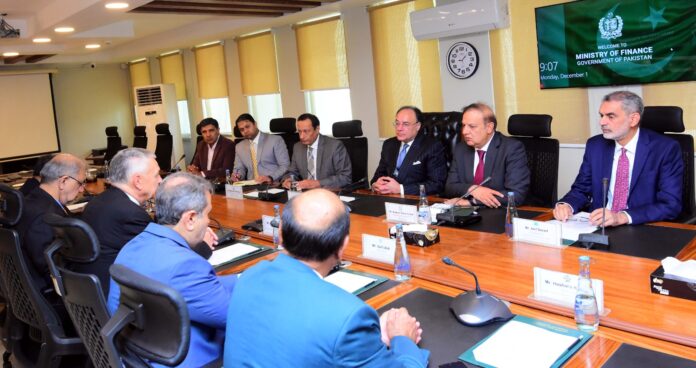
Muhammad Aurangzeb made these observations while talking to a delegation led by President of the International Federation of Accountants (IFAC) Jean Bouquot, who called on him accompanied by President of the South Asian Federation of Accountants (SAFA) Ashfaq Yousaf Tola, VP SAFA Humayun Kabeer, President ICAP Saifullah, and President ICMAP Ghulam Mustafa Qazi.
The meeting was also attended by Auditor General of Pakistan Maqbool Ahmad Gondal, Chairman of the Securities and Exchange Commission of Pakistan (SECP) Akif Saeed, and senior officials of the Ministry of Finance.
Senator Aurangzeb welcomed the visiting delegation and appreciated the global role played by IFAC in strengthening the accounting profession, promoting international standards, and advancing transparency and trust in financial reporting.
He noted that Pakistan’s sustainability agenda, climate finance commitments, and green economic initiatives align with the issues raised by the IFAC President.
He reaffirmed Pakistan’s commitment to advancing green finance initiatives, the implementation of the national green taxonomy, and the roll-out of sustainability frameworks through the State Bank of Pakistan.
He also underscored the importance of enabling SMEs to formalize their financial systems and improve disclosure capacity, particularly in industrial and export-oriented clusters where awareness and capability challenges persist.
Stressing the need to support Small and Medium-sized Enterprises (SMEs) in formalizing their financial reporting practices, the finance minister highlighted Pakistan’s proactive regulatory direction in digital assets and emerging technologies, where new institutional frameworks are being established to bring innovation into the formal, transparent, and compliant economy.
He emphasized that coordinated institutional support would be essential to ensure their smooth transition to modern reporting and documentation practices.
The finance minister further outlined Pakistan’s progress in regulating emerging technologies. With an increasing number of Pakistanis participating in global virtual asset markets, the government has proactively established the Pakistan Virtual Asset Regulatory Authority and introduced a crypto council to build a licensing-based, KYC- and AML-compliant regulatory regime that integrates innovation into the formal economy.
Earlier, Jean Bouquot briefed the finance minister on IFAC’s mission to act as the global voice of the accounting profession, with 188 member bodies across 143 jurisdictions.
He highlighted IFAC’s priorities in sustainability standards, audit quality, ethics, the impact of AI on the profession, capacity building for small and medium practitioners, and support for public sector accounting reforms.
He emphasized the growing global need for specialized training in non-financial assurance to maintain trust in integrated reporting.
Auditor General Maqbool Ahmad Gondal informed the delegation about Pakistan’s transition from cash to accrual-based IPSAS standards through new ERP systems and digital reforms that aim to achieve end-to-end electronic payments and receipts within the current fiscal year.
He noted that these steps will significantly enhance public financial transparency and international confidence in Pakistan’s fiscal reporting.
SECP Chairman Akif Saeed briefed the participants on Pakistan’s regulatory alignment with international bodies, including IOSCO, and highlighted reforms in insurance, pensions, and capital markets.
He reaffirmed the country’s commitment to full IFRS adoption and explained the phased implementation of sustainability disclosures for listed and unlisted companies. He commended the collaboration with ICAP and ICMAP in strengthening ESG practices and corporate reporting.
Ashfaq Yousaf Tola and Humayun Kabeer highlighted SAFA’s ongoing regional cooperation efforts, the challenges posed by geopolitical constraints, and the support extended by the Government of Pakistan during the current SAFA presidency.
They reiterated the importance of maintaining regional professional collaboration to strengthen economic integration and public trust.
ICMAP President Ghulam Mustafa Qazi reaffirmed the institution’s support to the government in training, capacity building, and integrating modern technologies such as AI into financial education. He expressed confidence in Pakistan’s improving economic trajectory and assured continued institutional cooperation.
The finance minister thanked the delegation for their visit, reaffirmed Pakistan’s commitment to strengthening partnerships in global and regional accounting frameworks, and extended best wishes for their engagements in Pakistan.